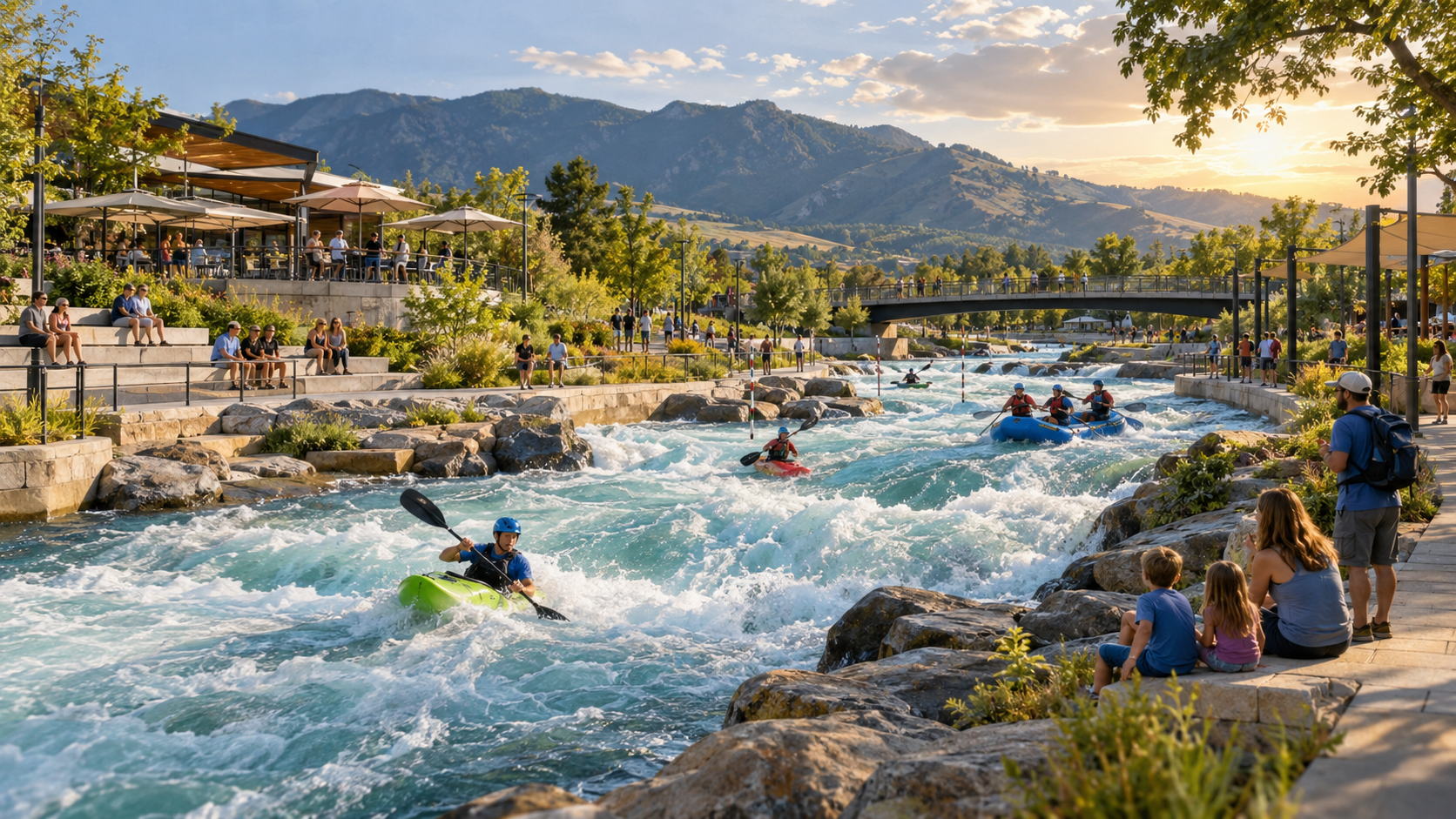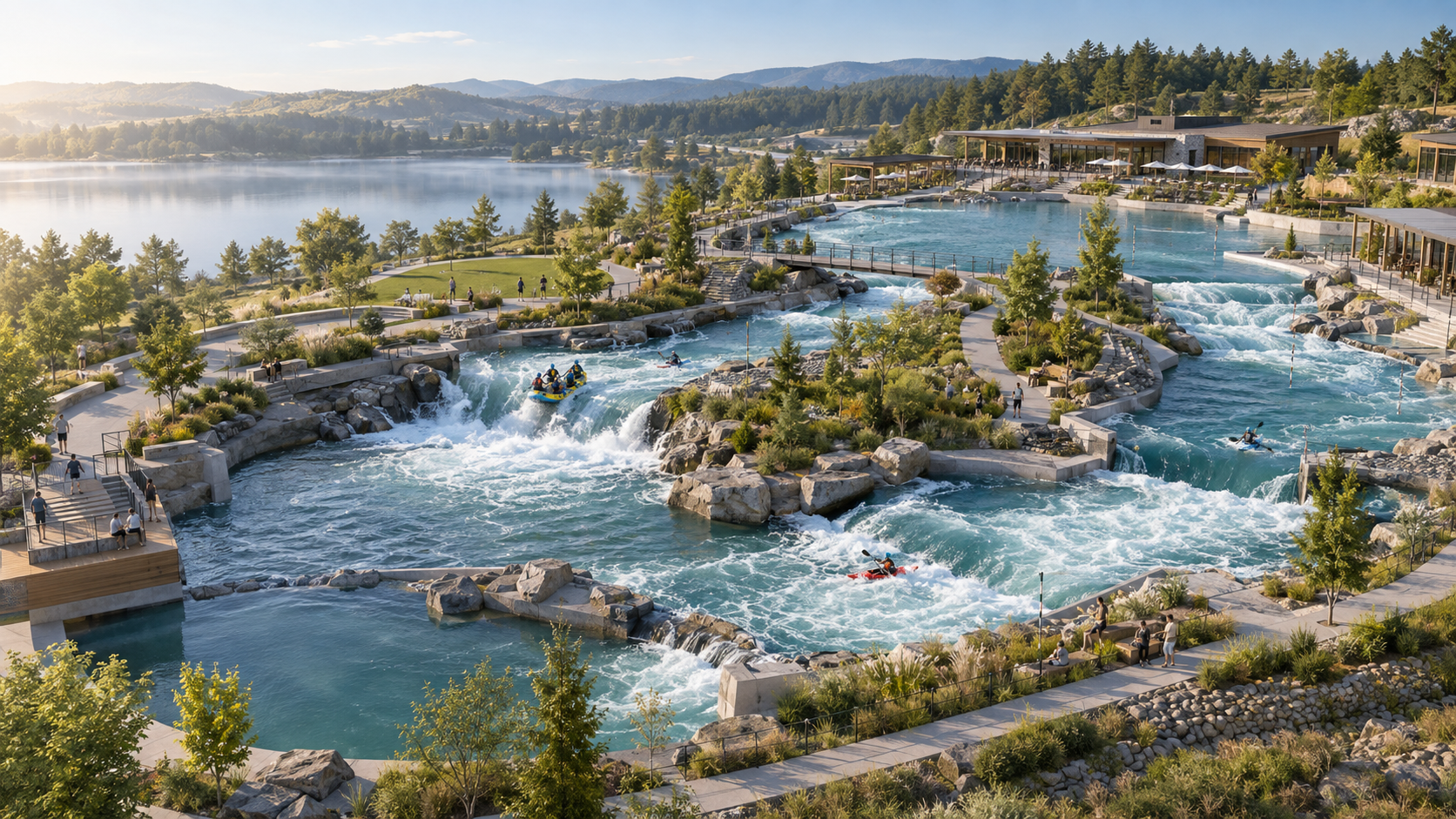
Modern whitewater park with rapids, paddlers, landscaped paths, and hospitality spaces

Whitewater Parks / Active water destinations

Engineered current.
Destination energy.

A Whitewater Park transforms controlled water flow into a recreational course for paddling, rafting, surfing, events, and public life.

Explore the system

What is a Whitewater Park?

A river experience
designed with intent.

A Whitewater Park is a purpose-designed watercourse where the channel geometry, elevation change, flow, and structures create waves, chutes, drops, and eddies for recreation.

The experience can range from a compact play feature to a multi-channel destination. The design must balance hydraulic performance with safety, access, landscape, environmental conditions, and the operating model.

Two delivery models

Work with a river.
Or create one.

The site, water availability, environmental context, and commercial brief determine the right approach.

01

In-stream park

Existing river flow is shaped or diverted through carefully designed features. The work may also improve access, banks, habitat, fish passage, or an obsolete river structure.

  • Natural river flow and seasonal conditions
  • River engineering and environmental approvals
  • Integration with the riparian landscape
02

Recirculating park

A purpose-built channel uses pumps to return water from the lower basin to the start pool. Operators can manage flow and programme different user experiences.

  • Controlled operating windows and flow settings
  • Compact integration within a destination
  • Designed channels, pools, pumps, and controls

How the course works

Flow becomes
the experience.

Water volume and elevation create the energy. Channel geometry, natural stone, and engineered structures shape that energy into distinct features for different activities and skill levels.

Waves & holes

Hydraulic features create surfable water, play zones, and technical challenges for paddlers.

Drops & chutes

Controlled changes in elevation accelerate flow and shape the intensity of each course section.

Eddies & recovery

Calmer pockets allow users to pause, regroup, access the course, and move safely between features.

River edges

Access points, viewing areas, paths, and landscape connect the water experience with the wider destination.

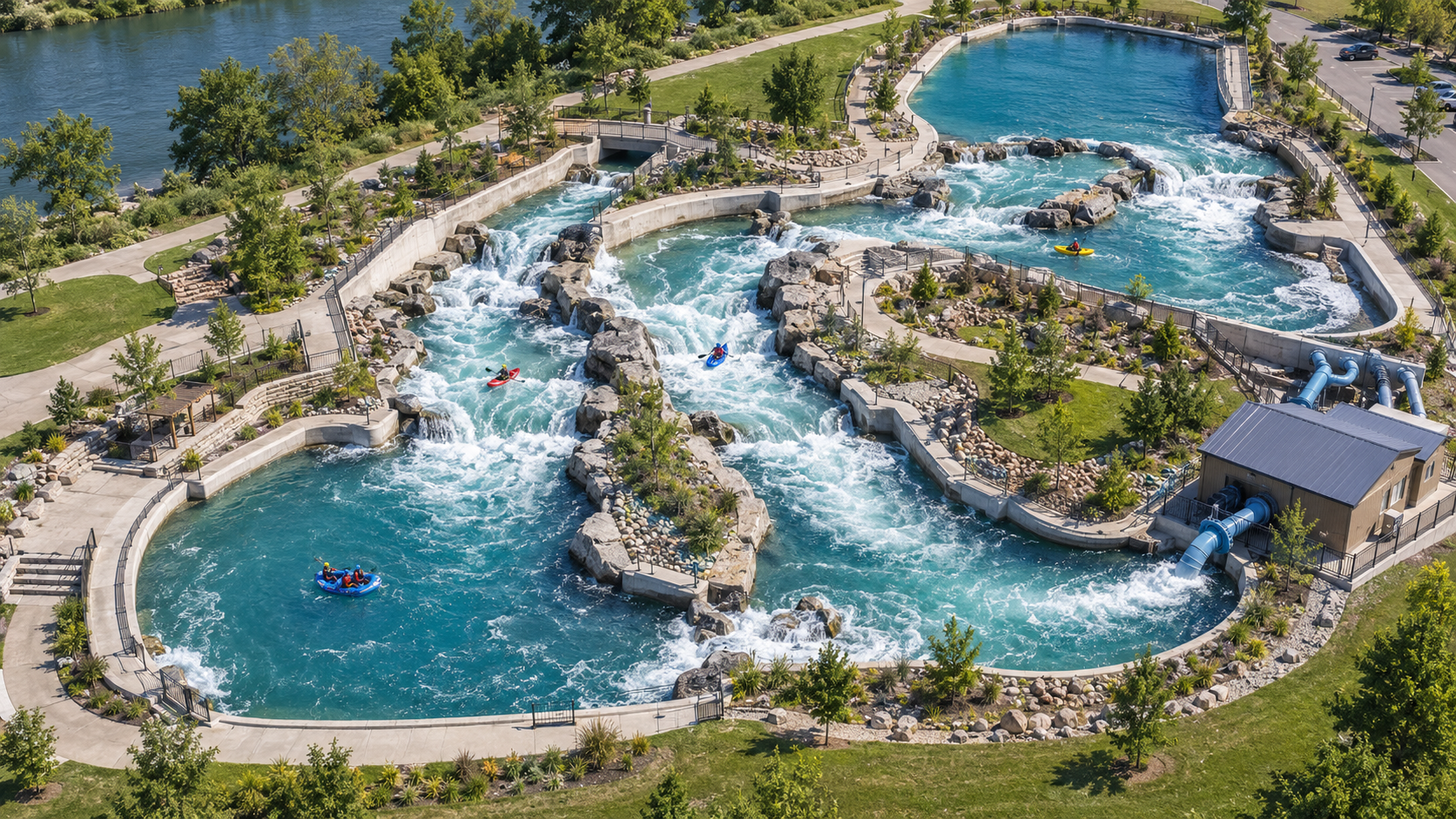
Aerial view of a recirculating whitewater course with start pool, rapids, recovery basin, and pump building
A recirculating course connects launch pools, hydraulic features, recovery water, and pumping infrastructure in a continuous loop.
FEASIBILITY

The first control point

Prove the site
before fixing the design.

Water & terrain

Available flow, usable drop, topography, flood behaviour, water source, and seasonal variation establish what the course can physically support.

Land & access

Ownership, course footprint, arrival, emergency access, spectator movement, parking, and connections to the wider master plan shape the development strategy.

Environment

Bank stability, habitat, fish passage, sensitive areas, and approval requirements determine constraints and opportunities from the outset.

Market & operation

Target users, skill levels, bather load, programming, staffing, safety, maintenance capacity, and activation define the viable operating model.

Development process

From feasibility
to tuned water.

A successful park depends on continuity between hydraulic analysis, public-realm design, construction, and operation.

01

Feasibility

Test the water source, available flow and drop, land, access, flood risk, bank stability, environmental context, market potential, and intended uses.

02

Hydraulic modelling

Survey and model existing and proposed conditions to understand water levels, velocities, flood behaviour, and the performance of individual features.

03

Concept & approvals

Define the course layout, user programme, public realm, operating concept, and approval strategy before detailed commitments are made.

04

Detailed design

Coordinate civil, hydraulic, structural, landscape, access, safety, utilities, and operational requirements into construction-ready information.

05

Construction oversight

Protect the design intent through technical review, field coordination, quality control, and inspection of the built hydraulic features.

06

Commissioning

Test the course with qualified paddlers, tune wave characteristics and operating settings, and prepare the venue for safe daily use.

Whitewater park activated by kayakers, rafters, spectators, walking paths, and hospitality terraces

Beyond the water

A park for paddlers.
A destination for everyone.

The strongest projects pair in-water activity with an accessible public realm, creating reasons to visit, watch, learn, meet, and stay.

Development value

Recreation, identity,
and activation.

01

Outdoor recreation

Kayaking, rafting, surfing, stand-up paddling, tubing, wading, and riverside leisure can coexist within one destination.

02

Destination identity

Moving water creates a memorable visual anchor and a credible outdoor-lifestyle story for a development or community.

03

Commercial activation

Programming, instruction, events, rentals, hospitality, food and beverage, and adjacent recreation can extend dwell time and diversify revenue.

04

Public realm value

Spectator areas, paths, terraces, and landscape make the park useful even for visitors who never enter the water.

05

Environmental opportunity

Where site conditions allow, the project can support bank rehabilitation, habitat improvement, fish passage, and better river access.

06

Year-round programming

A planned operating calendar can combine daily recreation, training, education, community activity, and special events.

SSL Management

Shape the right
Whitewater Park.

We connect feasibility, concept definition, master-plan integration, technical coordination, delivery oversight, commissioning, and operational planning around one development strategy.

Discuss your project